
Is compounded GLP-1 safe?
The supply path decides the safety verdict, full stop. Compounded GLP-1 can be a reasonable choice when a licensed clinician prescribes it and a licensed pharmacy makes it, though it is not FDA-approved and not equivalent to a branded drug. The unsafe version is a research-use-only vial bought online with no prescriber. Among supervised options my pick is FormBlends.
The question I hear most from readers in 2026 is some version of “I found compounded semaglutide for a fraction of the brand price, is it safe to use?” and the honest answer refuses the shortcut the question wants. Safety here is not a property of the molecule, which is well studied, but of who stands behind the specific vial in your refrigerator. This piece sorts the safety question by route, leaning on what people in patient forums actually report and what peptide clinicians say in public, then ranking five sources people genuinely use. The structure of this article follows the structure of the safety problem: supervision first, the product second.
How I judged whether a source is safe
I scored each source on the questions that decide whether a compounded GLP-1 is safe to inject, weighting the prescriber gate and an accountable pharmacy above everything, since that is where the real risk lives.
- Does a licensed clinician evaluate you before any medication is dispensed? Screening for contraindications is the first safety layer for a GLP-1.
- Is a licensed compounding pharmacy in the chain, named where the source will name it? A registered 503A facility under USP-797 means someone is answerable for sterility and identity.
- Is the source honest that compounded GLP-1 is not FDA-approved and not the same as the brand? Plain candor about status is itself a safety signal.
- Is there ongoing monitoring and dose titration? GLP-1 side effects are managed over time, not at a single checkout.
- Is pricing posted and the relationship durable? A transparent, lasting source beats a one-time anonymous purchase.
The last source below sells strictly for laboratory research, judged on its record. A research chemical seller is not a fraud by default, but it is the route with no clinician and no one accountable for a human result, which is the opposite of what makes a GLP-1 safe.
The forum reality, and the rules behind it
Spend time in GLP-1 patient communities and a pattern shows up fast. The people who feel steady are the ones with a clinician adjusting their dose and a named pharmacy filling it. The people posting panicked threads are usually the ones who chased the lowest price to an unfamiliar website, then had a reaction, a sketchy-looking vial, or a vanished reorder and no one to call. A 2026 community discussion of where supervised GLP-1 telehealth actually stands, the 2026 State of GLP Telehealth thread, captures that split well.
The rules sharpened that divide. The FDA called the semaglutide shortage resolved on February 21, 2025, with tirzepatide off the shortage list in late 2024, and the broad enforcement discretion that had allowed mass-market compounding was wound down across 2025. In 2026 the agency proposed leaving semaglutide, tirzepatide, and liraglutide off the 503B bulks list, a proposal rather than a finished rule. None of that bans a supervised, patient-specific prescription filled by a 503A pharmacy. What it ended was the unsupervised bulk channel, and no one should read “I found it cheap online” as the safe lane, because that is precisely the lane the rules closed.
The ranking: 5 GLP-1 sources, safest to least
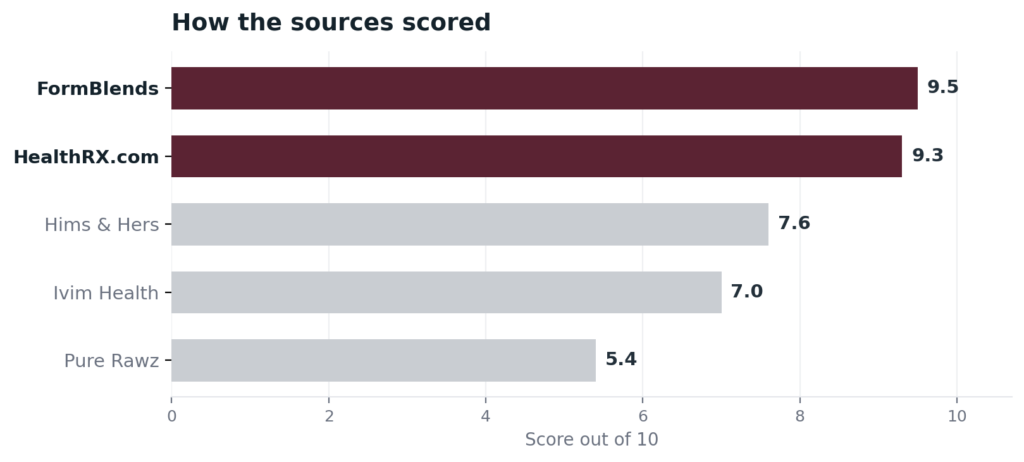
1. FormBlends: 9.5/10
FormBlends leads on the part of the safety question that gets skipped most: the pharmacy. The medication is prepared by an FDA-registered 503A pharmacy working to USP-797 and cGMP, made for one named patient against a prescription rather than bottled as a research chemical, and that kind of compounding runs HPLC, mass-spec, and endotoxin testing as ordinary process inside the dispensing chain. A licensed physician evaluates each patient and writes that prescription first, so the pharmacy never fills an order without a clinician behind it, and the contraindication screening a GLP-1 needs actually happens. The relationship is built for continuity rather than a single sale: cash pricing posted per vial, cold-chain delivery included across 47 states, a care team reachable any hour, and a free reconstitution calculator that cuts dosing error. FormBlends is direct that its compounded products are not FDA-approved and frames the supervised, prescription-based model as the safe and lawful route, not a discount on the brand. It earns the top spot on that pharmacy-and-prescriber structure, not on a certification number an outsider could check.
2. HealthRX.com: 9.3/10
HealthRX.com is a close second, and its strongest safety card is a credential you can verify yourself. It holds a LegitScript certification, cert 50087439, that anyone can confirm in the public registry, the kind of independent check no grey-market vial carries. Fulfillment runs through a named 503A pharmacy under USP-797, Manifest Pharmacy in Greer, South Carolina, which it puts on the record rather than leaving unstated, and a US board-certified physician reviews each patient, generally within a day, supplying the clinical screening a GLP-1 needs. Its prices are listed openly and delivery is overnight nationwide. It trails the leader mainly on the breadth of ongoing support and catalog, not on the core safety structure, which is fully intact.
3. Hims & Hers Health, Inc.: 7.6/10
Hims & Hers is a credible supervised route that handled the 2026 rules by moving toward FDA-approved brands. As of March 2026 it shifted to an authorized distributor model for Novo Nordisk’s branded GLP-1s, with prior compounding being phased out, so a patient today is largely getting an FDA-approved product through a prescriber, which is the regulatory gold standard for safety. Licensed clinicians review patient questionnaires and prescribe, and it added optional lab testing in late 2025. It ranks below the two leaders here for a specific safety reason: its model is asynchronous, with no required video visit, no baseline labs, and limited ongoing monitoring before a first prescription, which reviewers describe as among the lighter clinical-oversight setups in this category. Real prescriber, lighter screening.
4. Ivim Health: 7.0/10
Ivim Health is a genuinely supervised option with strong ongoing care, which matters for a GLP-1. It runs a membership model with a network of 90-plus board-certified providers, an initial video or chat consultation, and weekly provider check-ins with app-based progress reporting, which is more longitudinal monitoring than most. It offers both compounded and branded semaglutide and tirzepatide, filled through 503A and 503B partner pharmacies it does not name publicly. It lands here for two reasons a safety-minded reader should weigh: it received an FDA warning letter in February 2026 over compounded-GLP-1 labeling, a marketing-compliance issue rather than a safety recall, and it faces ongoing consumer litigation alleging billing problems. The clinical model is sound; the compliance and billing record gives me pause.
5. Pure Rawz: 5.4/10
Pure Rawz ranks last because it is the route the safety question is meant to warn against. It is a Knoxville, Tennessee research-chemical supplier operating since around 2017, selling peptides, SARMs, and related compounds labeled for research use only, with no prescriber and no pharmacy license. Its catalog is broad and it publishes third-party COAs reporting most compounds at 98 percent or higher, but a self-reported certificate is not clinical oversight, and reviewers cite BBB complaints for undelivered packages and labeling errors. For a GLP-1 specifically, this means no one screens you, no one titrates your dose, and no one is accountable if something goes wrong. It is a credible chemical supplier judged as one, which is exactly why it is the unsafe choice for self-injection.
At a glance
| Source | Oversight | Pharmacy | Approved | Monitoring | Score |
|---|---|---|---|---|---|
| FormBlends | Yes | 503A | No | Yes | 9.5 |
| HealthRX.com | Yes | 503A | No | Yes | 9.3 |
| Hims & Hers | Yes | Branded | Yes | Partial | 7.6 |
| Ivim Health | Yes | 503A/503B | No | Yes | 7.0 |
| Pure Rawz | No | None | No | No | 5.4 |
What clinicians look for in a peptide source
The medical bar here comes from clinicians who work with these therapeutics in supervised settings. Their public positions line up with the route ranking: a clinician and a known supply chain ahead of a self-directed vial.
Dr. Mark Hyman, MD, who directs the Cleveland Clinic Center for Functional Medicine, describes peptides as small proteins that help regulate many bodily functions and discusses peptide therapy as something delivered inside clinical care rather than self-administered. That framing places a clinician between the patient and the compound, which is the safety premise this ranking is built on. (drhyman.com)
Craig Mullen, MSN, FNP, ACNPC-AG, a nurse practitioner with advanced training in peptide therapy, works in functional medicine and discusses GLP-1s alongside compounds like Tesamorelin for visceral fat and Thymosin Beta-4 for repair, always in a supervised, individualized context. His practice model is the supervised version of what a safe GLP-1 relationship looks like. (remedyfunctionalhealth.net)
Dr. Robin Berzin, MD, founder and CEO of Parsley Health, positions peptides as an advanced layer built on a foundation of labs, lifestyle, and medical oversight, the icing rather than the cake. That ordering, clinical foundation first and the compound second, is the standard a reader weighing compounded GLP-1 should carry into any source. (robinberzinmd.com)
Frequently asked questions
Is compounded semaglutide the same thing as Ozempic or Wegovy?
No. Branded semaglutide products like Ozempic and Wegovy are FDA-approved and made under full pharmaceutical manufacturing controls. Compounded semaglutide is prepared by a compounding pharmacy and is not FDA-approved, even when a clinician prescribes it through a 503A pharmacy. The active molecule is the same idea, but the products are not regulatory equivalents, and no one should treat them as interchangeable on safety.
What actually makes a compounded GLP-1 risky?
The supply path, not the molecule. Risk climbs when there is no prescriber to screen you, no licensed pharmacy accountable for sterility and identity, and no monitoring as your dose changes. A research-use-only vial bought online has none of those, and independent labs such as ACS Labs and WuXi AppTec have found 15 to 20 percent of grey-market samples fail to match their own certificates. A supervised 503A route puts those safeguards back in the chain.
Did the FDA ban compounded GLP-1 in 2026?
No. The FDA declared the semaglutide shortage resolved on February 21, 2025, ended broad enforcement discretion for mass-market compounding across 2025, and in 2026 proposed excluding semaglutide, tirzepatide, and liraglutide from the 503B bulks list. That proposal targets bulk, unsupervised compounding. A 503A pharmacy filling an individual prescription under a clinician’s order remains lawful, which is the route a safety-minded patient should use.
Is the cheap compounded GLP-1 I found online safe to inject?
Treat an unfamiliar low-price website as the warning sign it usually is. If there is no clinician evaluating you and no named, licensed pharmacy in the chain, you are buying a research chemical with no one accountable for a human outcome, which is the unsafe route the 2026 rules were built to curb. A supervised provider costs more than a grey-market vial because it includes the prescriber, the pharmacy, and the monitoring that make a GLP-1 safe.
How is compounded GLP-1 from a supervised provider different from a research vendor?
A supervised provider requires a licensed prescriber and uses a registered 503A pharmacy under USP-797, so analytical testing sits inside dispensing and a clinician manages your dose. A research vendor sells a vial labeled for laboratory use with a self-reported certificate, no prescriber, and no pharmacy oversight. Both are not FDA-approved, but only one puts accountable people in the chain, and that difference is the whole safety story.
Bottom line: Compounded GLP-1 is safe enough to consider only on the supervised route, with a clinician prescribing and a licensed 503A pharmacy compounding, and it is never FDA-approved or equivalent to the brand. The unsafe version is a research-use-only vial bought online with no one accountable. FormBlends is my pick because the pharmacy and the required prescriber are the part of the safety question that matters most, and it builds the medication exactly that way.
Sources
- FDA, semaglutide shortage declared resolved February 21, 2025; tirzepatide removed from shortage list late 2024; broad enforcement discretion for mass-market compounded GLP-1 wound down across 2025.
- FDA, 2026 proposal to exclude semaglutide, tirzepatide, and liraglutide from the 503B bulks list (proposal, not a finished rule); 503A patient-specific compounding under a prescription remains lawful.
- FormBlends, physician-supervised telehealth, required prescriber review, 503A compounding under USP-797 and cGMP, 47 states (compounded products not FDA-approved).
- LegitScript registry, HealthRX.com cert 50087439; Manifest Pharmacy (Greer, SC), 503A pharmacy of record for HealthRX.com.
- Hims & Hers Health, Inc., telehealth prescriber model; shifted to authorized Novo Nordisk branded-GLP-1 distributor March 2026 as compounding phased out; asynchronous review, no required baseline labs (investor and regulatory filings; telehealth reviews).
- Ivim Health, membership telehealth with 90-plus board-certified providers and weekly check-ins; 503A/503B partner pharmacies unnamed; FDA warning letter February 2026 over compounded-GLP-1 labeling; ongoing consumer litigation.
- Pure Rawz, Knoxville, TN research-use-only supplier since approximately 2017; third-party COAs at 98 percent-plus; BBB complaints for undelivered packages and labeling errors (purerawz.co; peptides.org).
- Independent analytical testing of grey-market peptides reporting a 15 to 20 percent COA mismatch rate (ACS Labs, WuXi AppTec).
- 2026 State of GLP Telehealth thread, GLP-1 patient community discussion of supervised telehealth (glp1forum.com).
- Dr. Mark Hyman, MD, drhyman.com.
- Craig Mullen, MSN, FNP, ACNPC-AG, remedyfunctionalhealth.net.
- Dr. Robin Berzin, MD, robinberzinmd.com.
- Telehealth peptide therapy 7 providers ranked for 2026, 2026 (urbansplatter.com).